A History of Coast Guard Helicopter Aviation
From the Flying Banana to the Jayhawk — Eighty Years of Coast Guard Rotary-Wing Aviation
When most people picture a Coast Guard helicopter today, they picture an orange-and-white MH-65 Dolphin or an MH-60 Jayhawk. What is less well known is how early the Coast Guard saw what helicopters could do at sea. While the Coast Guard did not invent the helicopter — Igor Sikorsky did that, and the German Luftwaffe and Kriegsmarine actually fielded the first operational military helicopters during the Second World War — the Coast Guard was the first U.S. service to commit to rotary-wing aviation as a core mission, designed the first hydraulic rescue hoist, and ran the school that trained nearly all of America’s first military helicopter pilots.
This is a brief tour of every type of helicopter the Coast Guard has flown, starting with the Sikorsky that first carried blood plasma to a stricken destroyer in 1944, and ending with the MH-60T Jayhawk that will soon be the entire Coast Guard rotary-wing fleet.
Eighty Years of the Fleet at a Glance
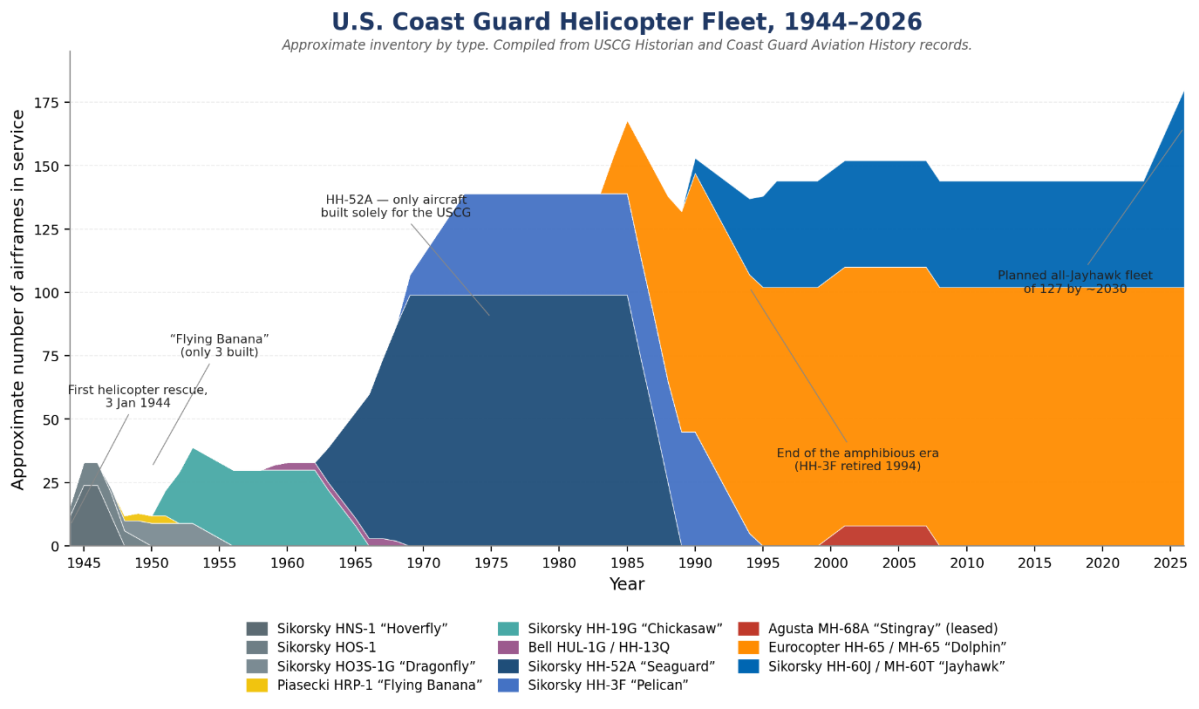
The chart below shows the approximate number of Coast Guard helicopters in service by type, year by year, since the first three Sikorsky HNS-1s arrived in 1943. A few patterns jump out: the experimental fleet of the 1940s and early 1950s was tiny — often fewer than 30 airframes total — and it was the arrival of the HH-52A Seaguard in 1963 that made rotary-wing aviation the backbone of the service. The handoff to the modern Dolphin-and-Jayhawk fleet happened over roughly a decade, from the mid-1980s to the mid-1990s. And at the far right of the chart, the planned transition to an all-MH-60T fleet of 127 aircraft by the end of this decade will be the largest Coast Guard helicopter fleet ever flown.
The Coast Guard Embraces the Helicopter
In 1942, the U.S. Navy’s Bureau of Aeronautics had little interest in helicopters. The Army Air Forces had ordered Sikorsky’s new R-4 and were beginning trials of their own. Commander William J. Kossler, a Coast Guard aviation engineering officer, sat on the inter-agency board overseeing rotary-wing development and saw what nobody in the Navy seemed to: a hovering aircraft that could land on a pitching deck or pluck a man from the water was a near-perfect Coast Guard tool.
Kossler convinced his superiors. By July 1942, with U-boats sinking American merchant ships at a catastrophic rate, ADM Ernest J. King assigned the Coast Guard responsibility for developing a sea-going helicopter — a remarkable vote of confidence in the smallest of the armed services. CDR Frank Erickson became Coast Guard Helicopter Aviator #1 and the service’s tireless evangelist for the new machine. The Navy Helicopter School, run by the Coast Guard at Floyd Bennett Field in Brooklyn, opened in 1943 and trained 97 of America’s first military helicopter pilots before it closed in 1945 — 71 of them Coast Guardsmen, the rest from the Navy, Army, British forces, and civilian agencies.
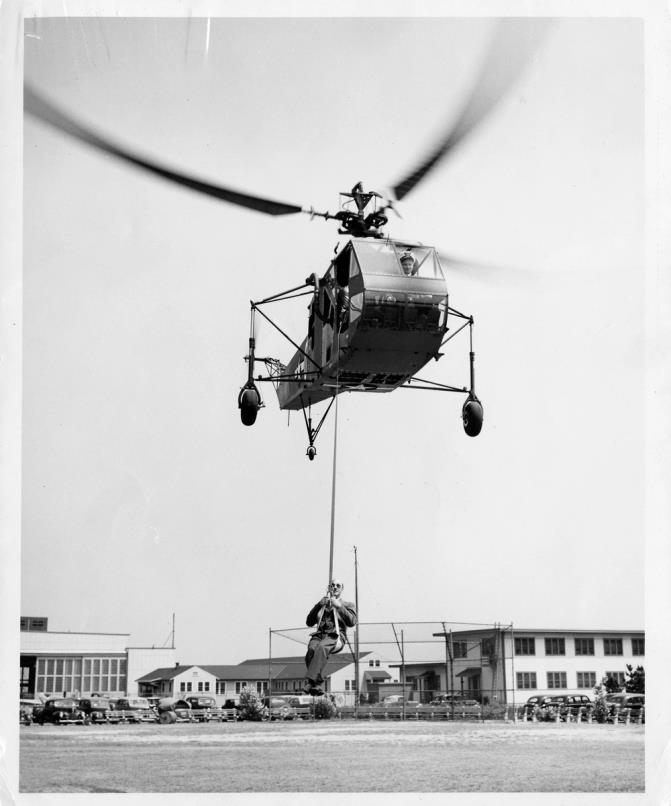
On January 3, 1944, Erickson flew two cases of blood plasma lashed to the floats of his Sikorsky HNS-1 from New York to Sandy Hook, where the destroyer USS Turner had just suffered a catastrophic explosion. Bad weather had grounded everything else. It was the first helicopter mercy flight — a delivery mission, not a survivor pickup. Two weeks later, on 16 January 1944, CDR Stuart Graham (helicopter aviator #2) flew a Sikorsky YR-4B from the deck of the British freighter SS Daghestan underway in the open Atlantic — the first helicopter takeoff and landing from a ship at sea.
The first true helicopter rescue came three months later and was an Army mission, not a Coast Guard one. On April 22-26, 1944, US Army Air Forces Lt. Carter Harman of the 1st Air Commando Group used a YR-4B — the same Sikorsky design the Coast Guard was flying as the HNS-1 — to extract a downed L-1 pilot and three wounded British soldiers from the Burma jungle, ferrying them out one at a time. Harman received the Distinguished Flying Cross. Operationally, the Germans had been there even earlier: the Luftwaffe’s Transportstaffel 40, equipped with Flettner Fl 282 Kolibris and Focke-Achgelis Fa 223 Drachen, was the world’s first operational helicopter squadron.
What the Coast Guard contributed was different and important. Erickson designed the first hydraulic rescue hoist. Coast Guard pilots developed techniques for shipboard helicopter operations and pioneered the use of the helicopter as a dedicated maritime rescue tool. In 1951, President Truman presented the Collier Trophy — aviation’s highest honor — jointly to the Coast Guard, the Department of Defense, and the helicopter industry, citing “outstanding development and use of rotary-winged aircraft for air rescue operations.”
Sikorsky HNS-1 (1943–1948)
The HNS-1 was the Navy designation for Sikorsky’s R-4, the world’s first production helicopter. The Coast Guard received its first three in 1943 for evaluation and training at Floyd Bennett Field in Brooklyn. With a 180-horsepower engine, fabric-covered fuselage, and a top speed of about 75 mph, it was barely an aircraft by modern standards. But it could hover, and that changed everything. Erickson and his small cadre used HNS-1s to develop the basic techniques of helicopter rescue, including the first hydraulic rescue hoist — designed by Erickson himself.
Sikorsky HOS-1 (1944–1950)
The development of the experimental XR-6, the HOS-1 was a slightly larger and more capable training helicopter. The Coast Guard used it primarily for pilot training and continued experimentation with shipboard operations. About a dozen served in the program before being retired in favor of more capable types.
Sikorsky HO2S-1 and HO3S-1 (1946–1953)
The HO3S-1 (the Sikorsky S-51) was the Coast Guard’s first truly operational rescue helicopter, larger and more capable than the wartime HNS. On April 6, 1949, an HO3S-1 made the longest unescorted helicopter ferry flight on record up to that time, traveling 3,750 miles from Elizabeth City, North Carolina, to Port Angeles, Washington — 57.6 hours of flight time over ten and a half days. Air Station Port Angeles, just across the Strait from Bellingham, has been a Coast Guard rotary-wing post ever since.
Piasecki HRP-1 Rescuer — the “Flying Banana” (1948–1952)
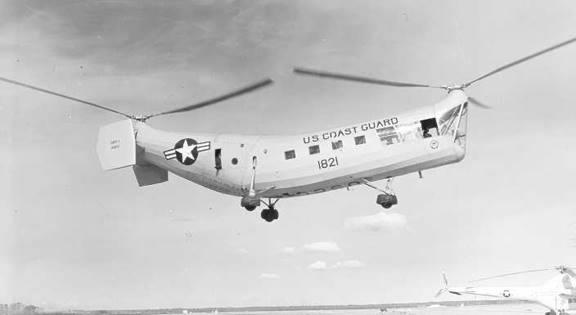
If any Coast Guard helicopter deserves its nickname, it is the HRP-1. Three were delivered beginning in November 1948 at a then-eye-watering cost of $256,912 each. The HRP-1 was the world’s first tandem twin-rotor transport helicopter — two large rotors, one fore and one aft, both spinning above a fabric-covered fuselage that bowed upward in the middle to keep the rotor disks from striking each other. The result looked exactly like a banana, and the crews who flew it called it nothing else.
The Banana was popular and great fun to fly, but it was badly underpowered. A single Pratt & Whitney R-1340 radial engine of 600 horsepower had to drive both 41-foot rotors, and on a hot day with a load aboard the aircraft struggled. The Coast Guard retired its three Bananas after only a few years of service. The HRP-1’s real legacy is its layout: every tandem-rotor helicopter that followed, including the Piasecki H-21 Workhorse and ultimately the Boeing CH-47 Chinook, traces its lineage to the Flying Banana.
Sikorsky HO4S-2G / HO4S-3G — HH-19G “Chickasaw” (1951–1966)
The HO4S was the Sikorsky S-55 — the first helicopter with the engine mounted in the nose driving a shaft up through the cockpit to the rotor head, which freed up a large cabin under the rotor for cargo or passengers. It carried a pilot and copilot up top, with seating for up to 10 people or seven stretchers below. Renamed the HH-19G when the joint designation system was adopted in 1962, the Chickasaw flew for the Coast Guard for over a decade, primarily in the search-and-rescue role from coastal air stations.
Bell HUL-1G / HH-13Q (1959–1969)
A small handful of Bell HUL-1Gs (the military designation for the Bell 47J Ranger, a passenger version of the famous bubble-canopy Bell 47) served the Coast Guard for shipboard operations aboard icebreakers. They were redesignated HH-13Q in 1962. The HUL was the smallest helicopter the Coast Guard has ever operated and remains a footnote in the fleet’s history, but it pioneered routine use of helicopters from cutter flight decks.
Sikorsky HH-52A Seaguard (1963–1989)
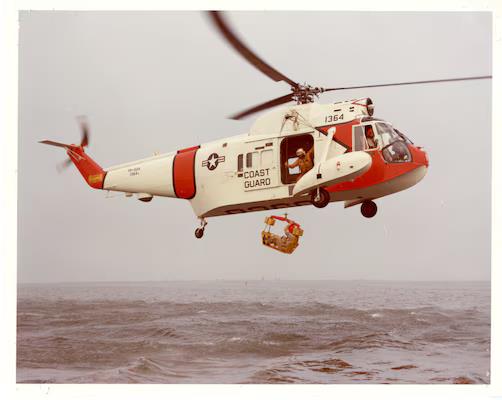
The HH-52A is, by one historian’s count, the only aircraft ever manufactured solely for the Coast Guard. Sikorsky funded a “fly before you buy” demonstration program to convince the service, and the resulting helicopter was tailored exactly to Coast Guard needs. It was the first helicopter with a flying-boat hull — it could land on the water, taxi, and take off again, an enormous capability for ocean rescue. It introduced the now-standard rescue swimmer platform on the right sponson and pioneered automatic flight control modes that allowed precise hovering at night and in poor visibility.
The Seaguard was beloved by its crews. Ninety-nine were built between 1963 and 1969 and they served the Coast Guard for more than 25 years, retiring in 1989 with an extraordinary record of lives saved — over 15,000 by some estimates. On December 10, 1981, an HH-52A landed aboard CGC Dependable for the 5,000th helicopter landing on her flight deck, the most ever recorded aboard any cutter.
Sikorsky HH-3F Pelican (1968–1994)
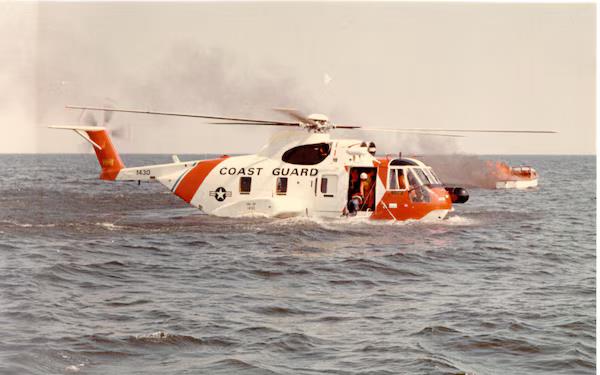
The HH-3F was a Coast Guard-specific version of the Air Force’s CH-3 (itself the famous “Jolly Green Giant” of Vietnam). Like the Seaguard before it, the Pelican had a true flying-boat hull and could land on the water — but it was much larger, with two turbine engines, a rear loading ramp, longer range, all-weather capability, and the radar and electronics needed for serious offshore search and rescue. Forty were procured, and they became the workhorse of long-range Coast Guard rescue for a quarter century.
The Pelican retired on May 6, 1994. With its retirement, the Coast Guard lost something it had possessed continuously since the HH-52A first flew: the ability to land its helicopters on the water. No Coast Guard rotary-wing aircraft has had that capability since. As one writer put it, the Pelican’s retirement ended “the Coast Guard’s amphibious era.”
Sikorsky CH-3E Sea King
A small number of CH-3E Sea Kings were briefly operated by the Coast Guard alongside the HH-3F to bridge the gap into the Jayhawk era. These were essentially the Air Force version of the same airframe family and served only briefly before being replaced.
Aérospatiale HH-65 / MH-65 Dolphin (1984–present)
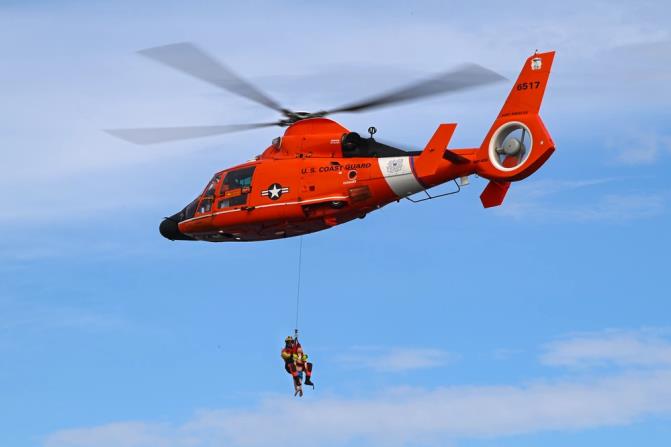
The HH-65 — based on the French Aérospatiale SA 365 Dauphin — was selected in the early 1980s as the Coast Guard’s new short-range recovery helicopter, replacing the HH-52A. The choice of a French design was politically controversial at the time, but the Dolphin proved itself quickly. It was the first Coast Guard helicopter with a fenestron (a ducted tail rotor enclosed in the vertical fin) instead of a conventional tail rotor — quieter, safer for ground crews, and instantly recognizable.
Originally designated HH-65A, the fleet has been progressively upgraded through HH-65B and HH-65C variants and now flies as the MH-65E with modern glass cockpits and digital avionics. On August 22, 1994, an HH-65A from Aviation Training Center Mobile became the first U.S. helicopter to reach the North Pole, deployed aboard the icebreaker Polar Sea.
Sikorsky HH-60J / MH-60T Jayhawk (1990–present)
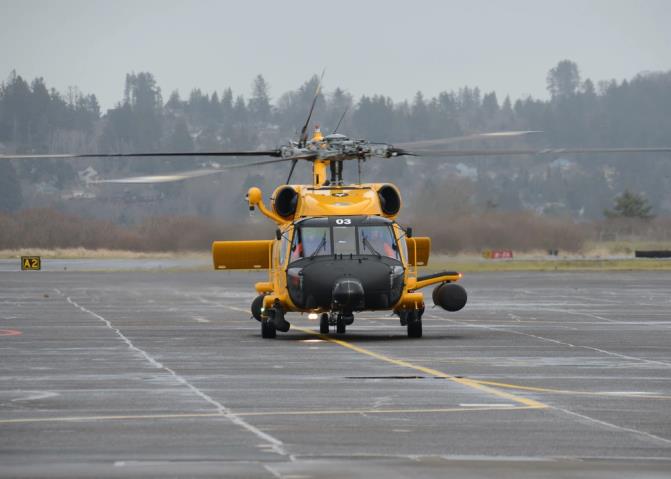
The HH-60J Jayhawk was developed in the late 1980s as the Coast Guard’s medium-range recovery helicopter, replacing the HH-3F Pelican. Based on the Navy’s SH-60 Seahawk, it is faster, lighter, and far more capable electronically than its predecessor. Forty-two were delivered between 1990 and 1996. Beginning in 2007, the fleet was rebuilt as the MH-60T with new avionics, sensors, and weapons mounts.
In 2023, the Coast Guard received approval to transition to an all-MH-60T helicopter fleet, eventually replacing the HH-65 as well, and to grow the fleet to 127 aircraft. By the end of this decade, every Coast Guard helicopter in the air will likely be a Jayhawk.
In 2016, several Jayhawks were repainted in a striking yellow scheme to celebrate the centennial of Coast Guard aviation. The yellow paint was a nod to the bright training colors worn by Coast Guard helicopters in the 1940s and 1950s — Frank Erickson’s HNS-1 had been painted exactly the same shade. The first centennial-livery Jayhawk was delivered to Air Station Astoria, Oregon, on January 15, 2016.
Air Station Port Angeles
The closest USCG air station to Bellingham — across the Strait of Juan de Fuca on Ediz Hook, Port Angeles.
- Established: June 1, 1935 — The first permanent Coast Guard air station on the Pacific Coast and today the oldest continuously operating air station in the Coast Guard.
- Aircraft: Three MH-65E Dolphin helicopters. The Echo upgrade brought a digital glass cockpit, new flight control system, and modern weather radar; Air Station Port Angeles received some of the first MH-65Es delivered to the fleet, in early 2021.
- Area of Responsibility: The full Puget Sound, the Strait of Juan de Fuca, the Washington outer coast, and inland as far as the Olympic Mountains. Their MH-65s respond as far north as Vancouver, British Columbia, often partnering with Canadian agencies. Anything over the water is theirs; anything over land they assist with.
- Missions: Search and rescue, maritime law enforcement, drug interdiction, fisheries patrol, marine environmental protection, homeland security, and logistical support to Sector Puget Sound boat stations including Bellingham, Neah Bay, Port Angeles, and Quillayute River.
- Typical Year: Approximately 150 SAR and law enforcement cases, saving roughly 20 lives and assisting 40 persons in distress.
- Notable Specialty: Mountain rescue. The Olympics are right next door, and Air Station Port Angeles has flown some of the highest-altitude HH-65 rescues on record — including a 6,900-foot hoist of an injured hiker from the summit of Brothers Mountain in 2007.
- Predecessors at the same hangar: Douglas RD-4 Dolphin amphibian (1935), Grumman JF-2 Duck, Grumman JRF Goose, Grumman J4F Widgeon, Sikorsky HO3S-1G (1946), Sikorsky HO4S “Eggbeater” (1951), Grumman HU-16E Albatross (the “Goat,” last fixed-wing aircraft, retired 1973), and the Sikorsky HH-52A Seaguard (1965-1988) before today’s Dolphins arrived.
Agusta MH-68A “Stingray” — the Italian Mako (2000–2008)
In the late 1990s, the Coast Guard faced a problem it had no aircraft to solve: drug smugglers were running open ocean “Go-Fast” boats at speeds no Coast Guard helicopter or cutter could match. The HH-65 and HH-60 were unarmed and built for rescue, not pursuit. Commandant ADM James Loy ordered the development of an armed interdiction unit, and in 2000 the Coast Guard leased eight Agusta A109E Power helicopters from Italy — designated MH-68A and unofficially known as the “Stingray” or sometimes the “Mako.”
The MH-68A was small, fast, agile, and armed with a precision rifle for disabling fire on smuggler outboards. Crewed by the new Helicopter Interdiction Tactical Squadron (HITRON) based at Cecil Field in Jacksonville, Florida, the Stingray was the first armed Coast Guard helicopter and pioneered tactics that are still used today.
The lease ended in 2008 and HITRON transitioned to armed MH-65s, but for eight years the Coast Guard’s most lethal aviation asset was an Italian executive helicopter painted Coast Guard colors.
What Comes Next
The Coast Guard is now eighty years into rotary-wing aviation. From three fabric-covered Sikorsky HNS-1s in a Brooklyn hangar to a planned all-Jayhawk fleet of 127 aircraft, the service has flown roughly a dozen distinct helicopter types. Several were one-of-a-kind oddities — the Flying Banana, the only-for-Coast-Guard Seaguard, the leased Italian Mako. The Coast Guard didn’t invent the helicopter, but it was the first U.S. service to commit to it as a core mission, and the rescue hoist that hangs beneath every modern Coast Guard helicopter is a direct descendant of the one Frank Erickson designed in 1944.
Sources
- Coast Guard Aviation Association. Coast Guard Aviation History. https://cgaviationhistory.org/
- U.S. Coast Guard Historian’s Office. Significant Dates in Coast Guard Aviation. https://www.history.uscg.mil/browse-by-topic/aviation/significant-dates/
- U.S. Coast Guard Historian’s Office. Rotary Wing Aircraft. https://www.history.uscg.mil/Browse-by-Topic/Assets/Air/All/Rotary-Wing/
- Igor I. Sikorsky Historical Archives. The World’s First Military Combat Rescue. https://sikorskyarchives.com/first-military-combat-rescue/
- Eshel, T. (2021, January 28). Iconic Coast Guard Aircraft. Defense Media Network. https://www.defensemedianetwork.com/stories/iconic-coast-guard-aircraft/